DIWA NO.601-1 Denmark Engineer Slide Rule
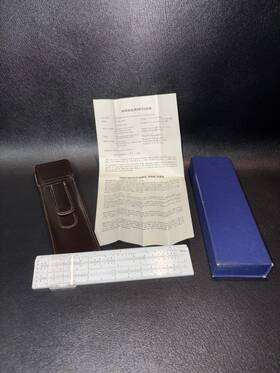
( Brand: Diwa ), ( Manufacturer Part Number: NO.601-1 ), ( Model: DIWA NO.601-1 ), ( Type: Slide Rule ), ( Case Included: Yes ), ( Case Type: Leather ), ( Country Of Origin: Denmark )
Review DIWA Vintage Denmark Engineer Slide Inch Rule Leather Case
The **Diwa No. 601-1 Denmark Engineer Slide Rule** is a meticulously crafted, full-featured analog calculating instrument that embodies the precision and elegance of mid-20th-century engineering and scientific computation. Designed by the Danish manufacturer Diwa, this slide rule belongs to the esteemed **Denmark Engineer series**, renowned for its robust construction, clear markings, and versatile functionality. The slide rule features a **10-inch (254 mm) scale length**, providing ample space for accurate readings and calculations across a wide range of mathematical operations. Its **curved body** is crafted from high-quality **celluloid**, a durable yet lightweight material that ensures smooth sliding and minimal wear over time, while the **metal frame** reinforces structural integrity, protecting the delicate scales from bending or misalignment.
At the heart of the Diwa No. 601-1 is its **duplex slide mechanism**, which allows for simultaneous multi-function calculations. The **front side** is equipped with the **standard logarithmic scales (CI, C, D, DF, K, and S)**, essential for multiplication, division, powers, and roots, while the **reverse side** expands its utility with specialized scales such as **trigonometric functions (S, T, ST), natural logarithms (LL), and hyperbolic functions (H, HL)**, making it ideal for advanced engineering, physics, and navigation tasks. The **curved DF scale** enhances precision for logarithmic interpolation, while the **K scale** simplifies exponentiation and root extraction, offering engineers and scientists a compact yet powerful tool for complex computations.
The slide rule s **clear, boldly inked scales** are meticulously aligned, ensuring readability even under varying lighting conditions. The **hairline cursor**, mounted on a sturdy metal frame, glides effortlessly along the scales, allowing for pinpoint accuracy when marking values. The **rotary switch** on the side enables quick toggling between the front and reverse sides, while the **fixed cursor** on the stock provides additional support for precise measurements. The **metal end caps** not only protect the slide rule from physical damage but also add a touch of industrial sophistication to its design.
Beyond its technical prowess, the Diwa No. 601-1 exudes a timeless aesthetic, blending functionality with a classic engineering look. Its **sleek, rounded edges** and **minimalist markings** reflect the Danish design philosophy of combining utility with understated elegance. Whether used for aerospace calculations, electrical engineering, or scientific research, this slide rule serves as both a practical tool and a testament to the enduring legacy of analog computation. For collectors, enthusiasts, and professionals alike, the Diwa No. 601-1 Denmark Engineer Slide Rule remains a prized artifact of a bygone era where precision, craftsmanship, and ingenuity converged in a single, portable instrument.
The **Diwa No. 601-1 (Denmark Engineer Slide Rule)** is a classic analog computing tool designed for engineering calculations, particularly in fields like mechanical, electrical, and civil engineering. Below is a detailed analysis of its pros and cons, followed by a conclusion and recommendation.
---
### **Pros of Buying a Diwa No. 601-1 Slide Rule**
1. **Precision for Basic Engineering Calculations**
The slide rule is highly effective for quick, approximate calculations involving multiplication, division, exponents, roots, and logarithms. It remains useful for tasks where exact precision isn t critical but speed and mental math are valued, such as in fieldwork, prototyping, or educational demonstrations.
2. **Portability and Durability**
Slide rules are compact and lightweight, making them easy to carry in a pocket or toolkit. The Diwa 601-1, in particular, is built with a sturdy plastic or metal frame, ensuring longevity even with frequent use. Unlike digital calculators, they are not prone to battery failure or software malfunctions.
3. **Development of Mathematical Intuition**
Using a slide rule encourages users to understand logarithmic scales, estimation techniques, and the underlying mathematics behind engineering problems. This can sharpen problem-solving skills and deepen conceptual knowledge, which is valuable for students or professionals who prefer hands-on learning.
4. **Aesthetic and Historical Appeal**
Slide rules are collectible items with a nostalgic charm, especially for engineers or enthusiasts who appreciate vintage technical tools. The Diwa 601-1, with its Danish engineering heritage, carries a sense of craftsmanship and professionalism that modern digital tools lack.
5. **Off-Grid Functionality**
Unlike electronic devices, a slide rule requires no power source. This makes it reliable in environments where electricity is unavailable, such as outdoor construction sites, remote fieldwork, or during power outages.
6. **Low Maintenance and Cost-Effective**
Once purchased, a slide rule has minimal ongoing costs. There are no batteries to replace, no software updates, and no risk of obsolescence due to technological changes. For occasional users, it can be a cost-effective alternative to a digital calculator.
7. **Compatibility with Traditional Engineering Practices**
In industries where analog methods are still preferred (e.g., aerospace, mechanical design, or certain academic disciplines), a slide rule can serve as a familiar and trusted tool. Some engineers use it as a secondary device to verify digital calculations or for quick sanity checks.
8. **Educational Value for Teaching Mathematics**
For educators, a slide rule can be an engaging tool to teach logarithmic functions, scientific notation, and estimation. It provides a tangible, visual way to demonstrate mathematical concepts that digital tools often abstract away.
---
### **Cons of Buying a Diwa No. 601-1 Slide Rule**
1. **Limited Precision and Accuracy**
Slide rules are inherently imprecise compared to digital calculators. They typically offer only about 3-4 significant digits of accuracy, which can lead to noticeable errors in critical calculations. For tasks requiring high precision (e.g., financial modeling, precise measurements in manufacturing), they are inadequate.
2. **Steep Learning Curve**
Mastering a slide rule requires practice. Users must memorize scales, understand how to align cursors correctly, and interpret results accurately. This can be frustrating for beginners or those accustomed to the instant feedback of digital devices.
3. **No Memory or Advanced Functions**
Unlike modern calculators, slide rules cannot store numbers, perform complex functions (e.g., trigonometry beyond basic scales, statistical operations), or handle programming. This limits their utility in modern engineering tasks that often require advanced computations.
4. **Time-Consuming for Complex Calculations**
Even for experienced users, slide rules can be slower than digital tools for multi-step calculations. Operations like square roots, trigonometric functions, or logarithmic conversions require multiple steps and careful alignment, which can be inefficient for repetitive tasks.
5. **Subject to Wear and Damage**
While durable, slide rules can suffer from misalignment of the cursor or scales due to rough handling, dust, or moisture. Over time, plastic models may develop scratches or warping, affecting readability. Metal models are more robust but heavier and potentially more expensive.
6. **Limited Availability of Parts and Repairs**
Finding replacement parts for a slide rule can be challenging, especially for older models. If the cursor or scales become damaged, repairs may require specialized knowledge or sourcing rare components.
7. **Outdated for Modern Workflows**
In most professional and academic settings today, digital calculators or software (e.g., MATLAB, Excel, or specialized engineering tools) are the standard. Using a slide rule may slow down workflows or require additional steps to cross-verify results, which can be impractical in fast-paced environments.
8. **No Digital Integration**
Slide rules cannot interface with computers or other digital tools. Exporting or logging results requires manual transcription, which introduces the risk of human error. This lack of integration can be a significant drawback in collaborative or data-heavy projects.
9. **Potential for Misuse or Misinterpretation**
Beginners or inexperienced users may misalign scales or misread results, leading to incorrect conclusions. Without proper training, the tool can become more of a liability than an asset.
10. **Declining Relevance in Education**
Many educational institutions have phased out slide rule training in favor of digital tools. While they may still be taught as historical artifacts, their practical use in modern curricula is minimal, which could limit their appeal to younger engineers.
---
### **Conclusion**
The Diwa No. 601-1 slide rule is a fascinating and functional tool for specific use cases, particularly in educational settings, historical preservation, or as a supplementary device for engineers who appreciate analog methods. Its strengths lie in its portability, durability, and ability to foster mathematical intuition, while its weaknesses limited precision, steep learning curve, and lack of advanced features make it unsuitable for modern, high-precision engineering tasks.
For **collectors, educators, or hobbyists**, the slide rule offers a unique blend of nostalgia and practical utility. For **professional engineers or students**, it may serve as a novelty or a backup tool but is unlikely to replace digital calculators or software. The decision to purchase one should be based on whether its advantages align with your specific needs and preferences.
---
### **Recommendation**
- **Buy the Diwa No. 601-1 if:**- You are an engineer or student interested in the history of computing tools and enjoy hands-on learning.
- You work in a field where quick, approximate calculations are sufficient (e.g., fieldwork, prototyping, or as a secondary verification tool).
- You appreciate vintage technical instruments and want to add a collectible item to your workspace.
- You teach mathematics or engineering and want to demonstrate analog computing methods to students.
- **Avoid purchasing it if:**- You require high precision for your work (e.g., financial analysis, aerospace engineering, or precise manufacturing).
- You prioritize speed and efficiency in calculations, as digital tools will be far more practical.
- You lack patience for the learning curve or are uncomfortable with manual estimation techniques.
- Your budget could be better spent on a high-quality digital calculator or software that offers advanced functions.
In summary, the Diwa No. 601-1 is a worthwhile purchase for enthusiasts and educators but may not be a practical investment for professionals who rely on digital tools for accuracy and versatility. Consider pairing it with a digital calculator for a balanced approach to engineering calculations.
Details:
Made in Denmark by the reputable brand Diwa, this slide rule comes with a luxurious leather case for storage and protection. The Vintage Diwa No.601-1 Denmark Engineer Slide 6 Rule is a high-quality hand tool designed for precision and accuracy. The compact size of 6 makes it easy to handle and carry for various engineering mathematical calculations.
part #: no6011 prices
- $15.82-$24.99
specifications mixedtoolsetse:
- brand: Diwa
- mpn: No.601-1
- model: Diwa No.601-1
- type: Slide Rule
- case included: Yes
- case type: Leather
- country of origin: Denmark
general mixedtoolsetse:
- condition: Used
- Tools Workshop Equipment > Hand Tools > Hand Tool Sets
offer mixedtoolsetse:
- options: Ship-to-home
- sold: 0
- started: February 24, 2026
- availability: In Stock
- quantity: 1
shipping mixedtoolsetse:
- cost: $10.64
- carrier: USPS
- service: USPS Priority Mail
- type: Calculated
- transit: 4-10 Days
- class: Expedited
seller mixedtoolsetse:
- city: Grosse Pointe, Michigan
- # reviews: 297
- rating: 100.0%
payments mixedtoolsetse:
- wallet: Paypal
- other
- credit card: Visa
returns mixedtoolsetse:
- policy: No Returns
